What Happens to Your DEWS and EOSB When You Leave the UAE
-
Mainland gratuity (EOSB) must be paid within 14 days of your last working day, usually in AED to a UAE account.
-
DEWS gives you a choice: withdraw in full or in part, paid locally or internationally, or leave the money invested and manage it from abroad.
-
Money in the mainland Voluntary Savings Scheme becomes withdrawable when employment ends, plus any gratuity frozen before your employer switched.
-
The UAE taxes none of it, but your next country of residence might, so timing the withdrawal matters.
-
Keep a UAE bank account open until every payment has landed.
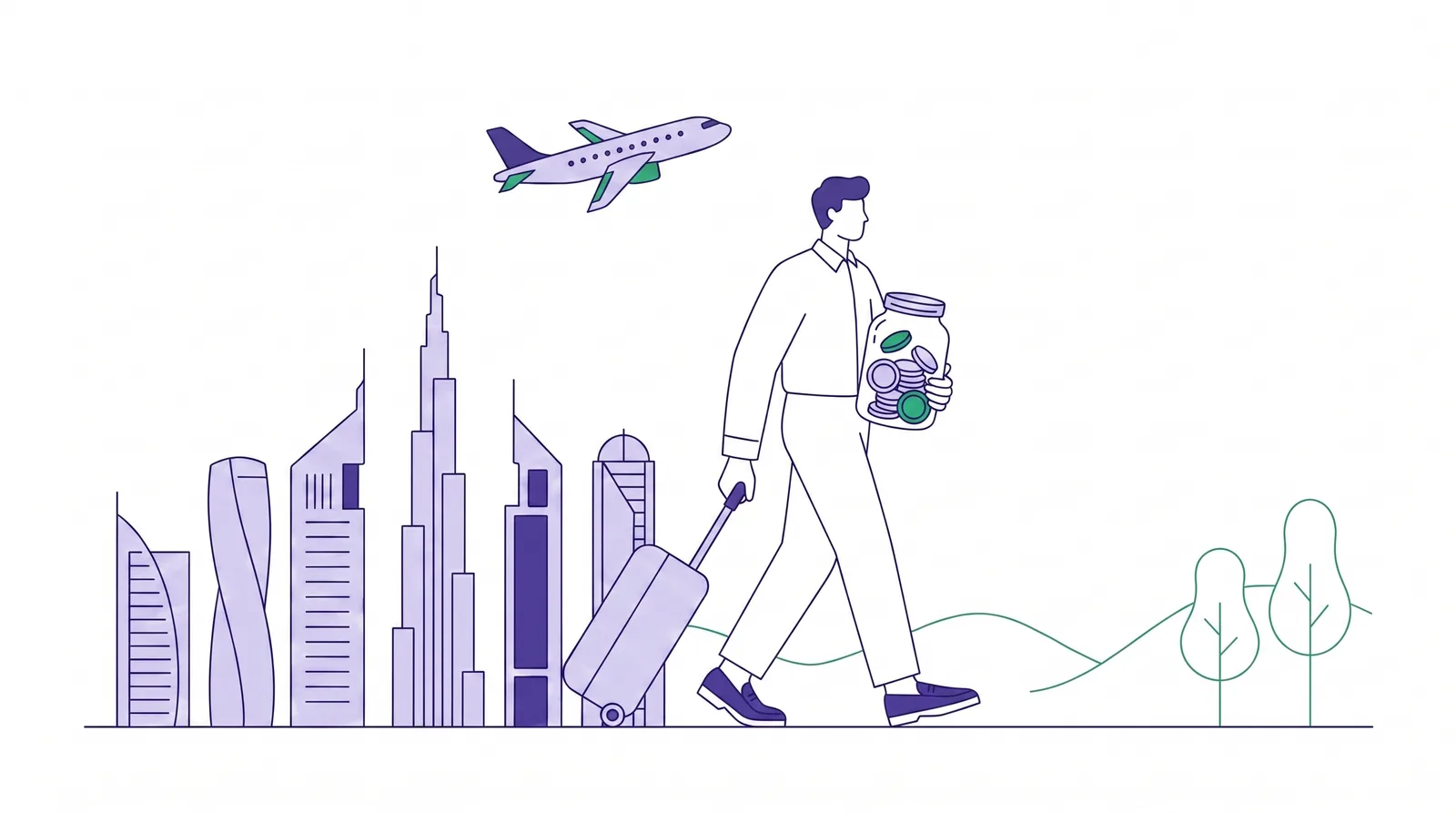
When you leave the UAE for good, your end-of-service money follows one of two paths. Mainland gratuity (EOSB) is a lump sum your employer must pay within 14 days of your end date. DEWS is different: it is already your money, and you choose whether to withdraw it, take part of it, or leave it invested after you fly out. Here is exactly what happens to each, and the mistakes that cost leavers real money.
What happens to your mainland gratuity when you leave?
Under Federal Decree-Law 33/2021, your employer must settle all end-of-service entitlements, gratuity plus unused leave and any other dues, within 14 days of your contract end date. In practice it is usually paid in AED to your UAE bank account as part of the final settlement, often alongside visa cancellation paperwork.
Three practical points:
-
Verify the number before you sign anything. Employers sometimes calculate on the wrong salary base or service period; check with the gratuity calculator and remember resignation no longer reduces gratuity under the current law, as explained in gratuity in resignation vs termination.
-
Do not close your bank account early. A closed account is the most common self-inflicted delay in final settlements.
-
If payment does not arrive in 14 days, you can escalate to MOHRE. The process and your options are in the UAE gratuity 14-day rule.
Quick example: basic salary AED 12,000, exactly 6 years of service, daily basic AED 400. Years one to five earn 21 days each (21 x 400 x 5 = AED 42,000) and year six earns 30 days (AED 12,000), so the settlement should include AED 54,000 of gratuity.
What are your DEWS options when you leave the UAE?
DEWS balances belong to you from the moment contributions are invested, so leaving the country does not trigger a forced payout. Once your DIFC employment ends, you have three options:
| Option | How it works | Watch out for |
|---|---|---|
| Full withdrawal | Request online, paid to a local or international bank account in your name | Bank charges on payment; FX conversion if not a USD account |
| Partial withdrawal | Take some now, leave the rest invested | Same charges per payment |
| Stay invested | Keep the account, manage funds online from abroad | No new contributions without a DIFC employer; keep contact details current |
Because DEWS funds are USD-denominated, a leaver returning to India, the Philippines or the UK is making a currency decision as well as an investment one.
There is no UAE tax either way. The real tax question sits in your destination country: some tax lump-sum receipts or investment growth once you become tax resident. Withdrawing before you acquire tax residency elsewhere is often cleaner, but rules differ by country, so check locally before you move rather than after.
What about the mainland Voluntary Savings Scheme and ADGM?
If your employer joined the Voluntary Savings Scheme under Cabinet Resolution 96/2023, two amounts come into play when you leave:
-
Your scheme savings (employer contributions plus any voluntary top-ups and returns), which you can withdraw once employment ends.
-
Your frozen pre-scheme gratuity, calculated on your basic salary at the date your employer switched, which the employer still owes you directly.
Claim both; leavers regularly forget the second. The background is in DEWS and other end-of-service savings schemes, and free-zone differences are compared in DIFC DEWS vs ADGM vs mainland gratuity.
Should you withdraw your DEWS or leave it invested?
There is no universal answer, but the decision usually turns on three questions:
-
Do you need the money now? If it is earmarked for a house or resettlement costs, withdraw and be done.
-
Where will you pay tax? If your new country taxes foreign investment accounts punitively, consolidating there may be simpler; if it taxes lump sums on arrival, delaying or withdrawing before the move may help.
-
Is DEWS your cheapest option? Compare its fund fees against a brokerage account in your destination. For some leavers DEWS remains a perfectly good low-effort pot; others can invest more cheaply at home.
Whatever you choose, the exit weeks are busy and mistakes are expensive. The wider sequence (loans, cards, deposits, accounts) is covered in the leaving the UAE financial checklist.
FAQ
Can my employer hold my gratuity until I repay loans or return equipment?
Employers can deduct documented amounts you owe from the final settlement, but they cannot indefinitely withhold your EOSB. If the deduction looks inflated or payment stalls past 14 days, raise it with MOHRE.
Is there a deadline to withdraw DEWS after leaving?
You can leave savings invested and there is no forced payout on leaving the UAE. Practical housekeeping still applies: keep your login, email and beneficiary details current so the account never goes stale.
Will I pay tax on my gratuity or DEWS when I take it home?
The UAE charges nothing. Your home or destination country may tax the receipt or subsequent growth depending on its rules and your tax residency dates. Get country-specific advice before transferring large sums.
My employer never paid my gratuity and I already left the country. Can I still claim?
Yes. Labour claims can be filed with MOHRE and pursued through the courts even from abroad, though it is slower. Document everything before departure: contract, salary certificates, end-date letter and settlement correspondence.
Does the 14-day rule apply to DEWS too?
The 14-day settlement rule is about employer-paid entitlements. DEWS is employee-owned money held by the plan, so withdrawals follow the plan's processing timelines once you submit a request, typically days to a few weeks rather than months.
Related reading
Sources and References
-
Zurich Workplace Solutions, DEWS employee pages; leaver options to stay invested, make partial or full withdrawals online, and receive payment locally or internationally (zws.zurich.ae)
-
UAE Government portal, end of service benefits for private sector workers; the requirement to settle entitlements within 14 days of the contract end date under Federal Decree-Law 33/2021 (u.ae)
-
Morgan Lewis, The UAE Alternative Savings Scheme: An Update; treatment of scheme savings and pre-scheme accrued gratuity under Cabinet Resolution 96/2023 (morganlewis.com)
This article is for general information and does not constitute financial or tax advice. Settlement procedures, plan processing times and destination-country tax rules change, so confirm current terms with your employer, the DEWS administrator and a local tax adviser before you leave.
Published on 9 September 2026.