How to Invest Monthly From Your Salary in the UAE (DCA Guide 2026)
-
Dollar-cost averaging (DCA) means investing a fixed amount every month regardless of market conditions, which removes timing decisions entirely.
-
AED 2,000 a month for 20 years grows to roughly AED 1.04 million at 7% annual returns, from AED 480,000 of contributions.
-
Automate it: robo-advisors accept recurring AED transfers, and brokers like IBKR offer recurring investment features.
-
Invest within days of salary arriving, before spending pressure builds; treat it like a bill.
-
Avoid 25-year contractual "savings plans"; a DIY monthly plan does the same job at a tenth of the cost with no exit penalties.
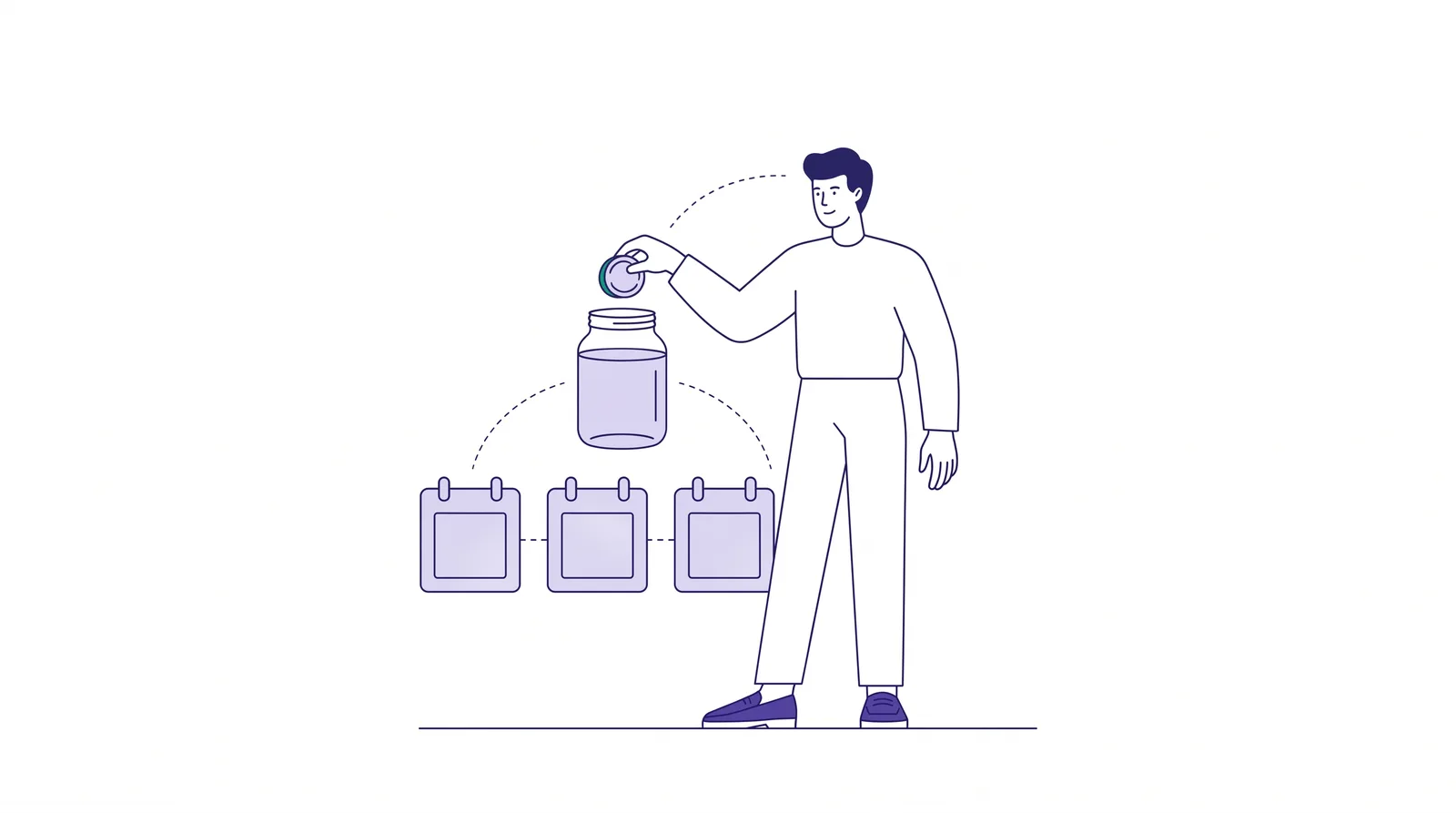
The simplest reliable way to build wealth from a UAE salary is to invest a fixed amount every month into a diversified, low-cost portfolio, automatically, right after payday. This approach is called dollar-cost averaging (DCA). It needs no market forecasts, no timing skill and about ten minutes of setup. At realistic returns, AED 2,000 a month becomes roughly a million dirhams over 20 years. Here is how to set it up in the UAE.
What is dollar-cost averaging and why does it work?
DCA means investing the same amount at a fixed interval, say AED 2,000 on the 28th of every month, whatever the market is doing. When prices are high, your money buys fewer units; when prices fall, the same money buys more. Over time you accumulate at an average price without ever deciding whether "now is a good time".
Its real power is behavioural. Most investors lose returns not to bad funds but to bad timing: waiting for a dip that never comes, panic-selling in crashes, or investing a bonus at a peak and getting discouraged. A standing monthly investment removes all of those decisions. It also matches how you are paid: a monthly salary maps naturally onto monthly investing.
DCA is the mechanism. What you buy still matters: for most people that means broad, low-cost index funds, as explained in our guides to starting investing in the UAE as a beginner and ETF investing for UAE expats.
What could AED 2,000 a month realistically become?
Assume you invest AED 2,000 every month for 20 years, a total of AED 480,000 in contributions. At different average annual returns (nominal, in USD terms, compounded monthly):
| Average annual return | Value after 10 years | Value after 20 years | Growth above contributions (20y) |
|---|---|---|---|
| 5% (conservative) | ~AED 311,000 | ~AED 822,000 | ~AED 342,000 |
| 7% (realistic for global equities) | ~AED 346,000 | ~AED 1,042,000 | ~AED 562,000 |
| 9% (optimistic) | ~AED 387,000 | ~AED 1,336,000 | ~AED 856,000 |
Three things stand out. First, the second decade does most of the work: at 7%, the portfolio roughly triples between year 10 and year 20. Compounding rewards people who start early and do not stop. Second, even the conservative case turns AED 480,000 of savings into over AED 800,000. Third, these are nominal figures; inflation will reduce their purchasing power, which is why equities (which historically outpace inflation) are the sensible engine for 20-year money.
To see how much you personally need to invest monthly to close your retirement shortfall, use the retirement gap calculator, which factors in your end-of-service gratuity.
How do you automate monthly investing in the UAE?
Automation is what makes DCA survive busy months and shaky markets. You have three practical routes as a UAE resident.
Route 1: robo-advisor with a recurring transfer
Platforms such as Sarwa and StashAway (both regulated in the UAE region) let you set up a recurring monthly deposit from your UAE bank account in AED. The platform converts, invests into a diversified ETF portfolio matched to your risk level and rebalances automatically. This is the closest thing to fully hands-off investing available here. Fees typically run around 0.5 to 1% per year on top of ETF costs. See our comparison of Sarwa vs StashAway vs DIY ETFs.
Route 2: DIY broker with recurring investments
Interactive Brokers (IBKR) supports AED deposits from UAE banks and offers a recurring investment feature that buys a chosen stock or ETF on a schedule. You set up a monthly standing order from your bank to your broker, and a recurring buy inside the platform. Total costs can be under 0.3% per year all-in, the cheapest route, at the price of a little more setup effort. Our guide to accessing US markets via Saxo and IBKR walks through funding and currency conversion.
Route 3: semi-manual with a calendar rule
If your platform lacks automation, a fixed rule works: every payday plus two days, transfer and invest the same amount. Put it in your calendar. The risk is that "manual" becomes "optional" in a falling market, which is exactly when buying matters most.
Whichever route you choose, follow the pay-yourself-first sequence: salary arrives, investment leaves within a few days, and you live on the remainder. Investing what is "left over" at month-end reliably produces zero.
What should you sort out before you start?
Three prerequisites, in order:
-
Emergency fund first. Three to six months of expenses in an accessible account, so a job loss never forces you to sell investments at a bad time. Park it somewhere earning a real rate; compare options in best savings accounts in the UAE.
-
Clear expensive debt. Credit card balances at 2.5 to 3% per month (over 30% per year) outpace any realistic investment return. Pay those down before investing beyond a token amount.
-
Set the amount honestly. A sustainable AED 1,500 beats an ambitious AED 4,000 you cancel in month four. You can raise the standing order with every salary increase.
Why not just use a 25-year savings plan instead?
Because insurance-linked "savings plans" sold in the UAE do the same monthly investing while charging fees that commonly consume 30 to 50% of your potential final value, and they penalise you for stopping early. A DIY or robo DCA plan is flexible: you can pause, raise, lower or withdraw without exit charges. Before signing anything with a 20 or 25 year term, read the savings plan trap and run the numbers in the savings plan fee calculator. The difference on AED 2,000 a month can exceed AED 400,000 over 25 years.
FAQ
Is it better to invest monthly or wait and invest a lump sum?
If you already hold a lump sum, investing it sooner has historically beaten drip-feeding it in about two-thirds of periods, because markets rise more often than they fall. But for money that arrives as salary, monthly investing is not a compromise, it is simply investing each dirham as soon as it exists. DCA also protects you from the regret and panic that cause real losses.
What return should I assume for planning?
For a diversified global equity portfolio, 6 to 8% per year nominal in USD is a reasonable long-run planning range; use 5% if you want a conservative plan or hold a mixed stock-bond portfolio. Treat anything promising a "guaranteed" 10%+ as a red flag.
Which day of the month is best to invest?
It barely matters statistically. What matters is consistency and investing soon after salary arrives so the money never sits in your spending account. Payday plus one or two days is a good default.
Should I stop my monthly investing when markets crash?
No. Crashes are when your fixed monthly amount buys the most units, which is where much of DCA's long-term benefit comes from. Stopping in downturns and restarting after recoveries quietly converts DCA into buy-high-only investing.
Related reading:
Sources and References
-
Interactive Brokers, funding documentation; AED deposits from UAE banks and recurring investment functionality (ibkrguides.com)
-
StashAway MENA, platform guides; recurring AED deposits and managed ETF portfolios for UAE-region investors (stashaway.ae)
-
Growth projections are the author's compound-growth calculations at stated assumed rates of 5%, 7% and 9%, compounded monthly; they are illustrations, not forecasts
This article is for general information and does not constitute financial or investment advice. Investing puts your capital at risk, returns are not guaranteed, and past performance does not guarantee future results. Platform features and fees change, so confirm current terms with each provider before setting up any recurring investment.
Published on 9 September 2026.