How to Get Out of Debt on a UAE Salary (2026 Plan)
-
Getting out of debt in the UAE comes down to four steps: list every debt with its real rate, pick a payoff order (avalanche or snowball), free up a fixed monthly attack amount, and negotiate with your bank before you ever miss a payment.
-
The avalanche method (highest rate first) almost always saves the most money. In our worked example it saves roughly AED 3,000 versus snowball on the same debts.
-
Credit cards at 2.5 to 3.5% per month are nearly always your most expensive debt, so they usually go first.
-
UAE banks can restructure, consolidate, or defer payments, and CBUAE consumer protection rules require them to deal with financial hardship fairly. Ask early, in writing.
-
Free help exists: your bank's hardship team and Sanadak, the UAE's financial ombudsman. Be wary of paid "debt fixers" who charge upfront fees.
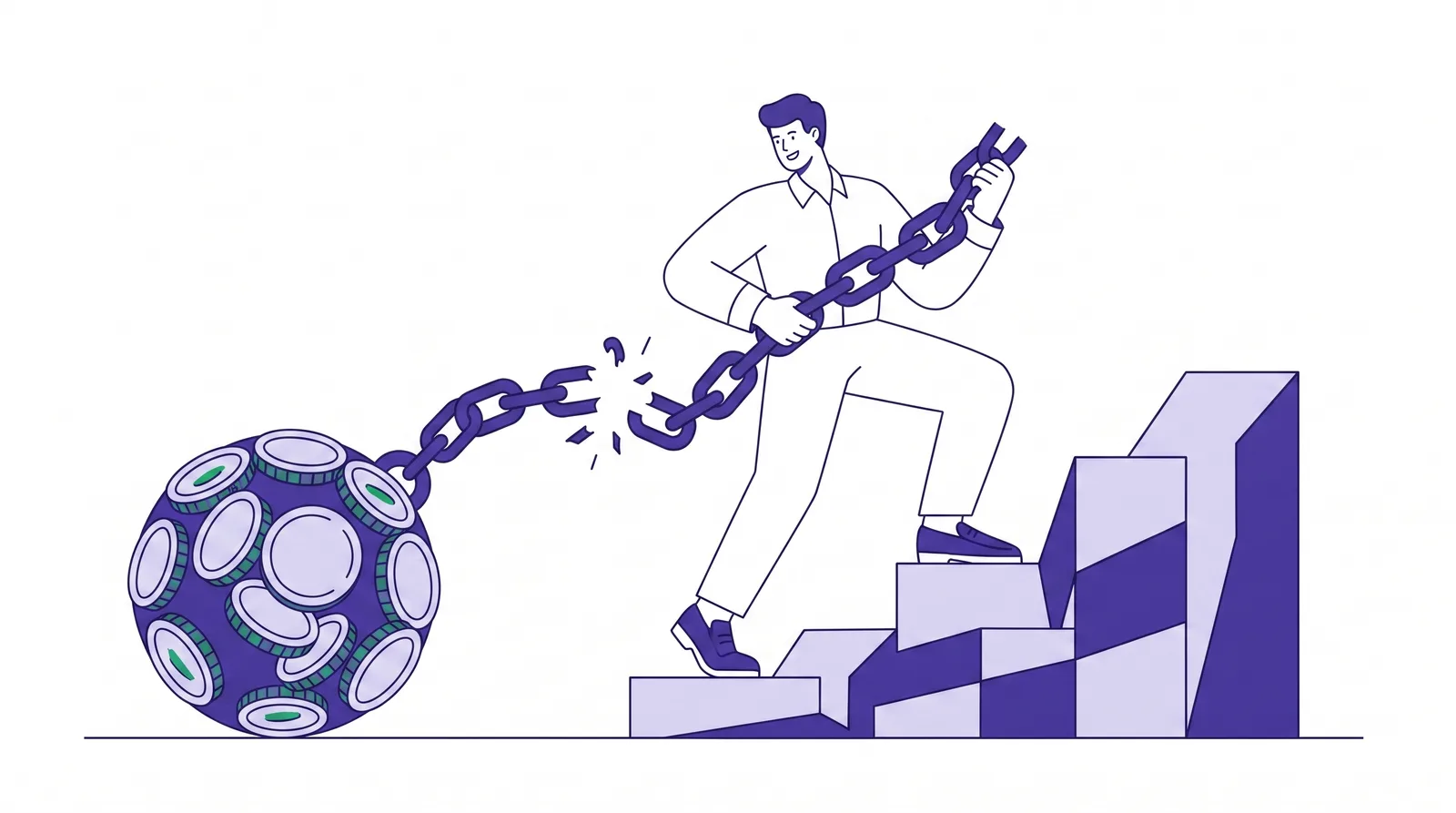
Getting out of debt on a UAE salary means doing four things in order: write down every debt with its true interest rate, choose a payoff order, commit a fixed monthly amount on top of your minimums, and talk to your bank about restructuring before anything is missed. Expats have no home-country safety net here, but they also have a big advantage: no income tax, which means a raise or a cut expense converts fully into debt repayment.
This guide gives you the exact sequence, with AED numbers.
Step 1: How much debt do you actually have?
You cannot plan around a fog. List every debt in one table: outstanding balance, interest rate (converted to a comparable basis), minimum payment, and any security attached (a salary assignment, a security cheque, a car).
Two UAE-specific points matter here:
-
Credit card rates are quoted monthly (typically 2.5 to 3.5% per month, roughly 30 to 45% per year). A card at "2.99% per month" is not cheaper than a personal loan at "8% per year"; it is about four times more expensive.
-
Personal and car loans may be quoted flat or reducing. A flat rate roughly doubles when converted to a reducing (real) rate. Our guide to personal loan rates in the UAE explains the conversion.
Pull your free-of-surprises view from the Al Etihad Credit Bureau (AECB), the UAE's federal credit bureau; your AECB report lists every bank facility in your name. Then check where you stand against the 50% debt burden ratio (DBR) cap with the DBR and loan affordability calculator. DBR is your total monthly debt payments divided by monthly income; UAE banks cannot lend to you past 50%, and if you are near it, restructuring (Step 4) matters more than optimization.
Step 2: Avalanche or snowball, which pays off debt faster?
Both methods use the same engine: pay minimums on everything, then throw every spare dirham at one target debt. They differ only in which debt you target first.
| Method | Order | Best for | Trade-off |
|---|---|---|---|
| Avalanche | Highest interest rate first | Minimizing total interest and time | First "cleared debt" moment can take longer |
| Snowball | Smallest balance first | Motivation, quick wins | Costs more in interest |
A worked example in AED
Meet a Dubai resident earning AED 18,000 per month with two debts:
-
Credit card: AED 25,000 outstanding at 3.25% per month, minimum payment about AED 1,250
-
Personal loan: AED 18,000 remaining at 8% per year reducing, instalment AED 815
After budgeting, they can put AED 1,500 per month toward debt on top of the minimums (about AED 3,565 total per month).
Avalanche (card first): pay AED 2,750 to the card and the AED 815 loan instalment. The card clears in roughly 11 months, then the full AED 3,565 hits the loan, which clears about 3 months later. Total interest: approximately AED 6,300, debt-free in about 14 months.
Snowball (smaller loan first): pay AED 2,315 to the loan and AED 1,250 minimum to the card. The loan clears in about 8 months (a satisfying early win), but the card compounds at 3.25% per month the whole time. Total interest: approximately AED 9,300, debt-free in about 15 months.
| Avalanche | Snowball | |
|---|---|---|
| First debt cleared | Month 11 | Month 8 |
| Debt-free | About month 14 | About month 15 |
| Total interest paid | About AED 6,300 | About AED 9,300 |
Same income, same debts, same monthly effort: avalanche saves roughly AED 3,000 here, purely because the card's monthly rate dwarfs the loan's annual rate. The wider the gap between your cheapest and most expensive debt, the more avalanche wins. If your rates are all similar, pick snowball for the psychology; finishing matters more than the method.
One caveat: whichever method you choose, stop paying only the minimum on cards. The minimum payment trap can stretch a card balance across a decade.
Step 3: How do you free up cash for repayments on a UAE salary?
The attack amount, the AED 1,500 in the example, is the whole game. On a UAE budget the biggest levers are usually:
-
Rent: renegotiate at renewal or move one metro stop out. AED 500 to 1,500 per month is realistic in Dubai and Abu Dhabi.
-
Remittances: if you send money home, pause or reduce transfers temporarily and switch to the cheapest transfer channel. Family conversations are hard; default interest at 3% per month is harder.
-
Car costs: a car loan plus insurance plus Salik plus fuel often exceeds AED 2,500 per month. If you are deep in expensive debt, downgrading the car is the single fastest fix. See our guide to car loans in the UAE.
-
Windfalls: commissions, bonuses, and gratuity from a job change go straight to the target debt, not to lifestyle.
Run your numbers through the UAE budget calculator to find your realistic safe-to-spend figure, then automate the attack payment for the day after salary day.
Step 4: Can you negotiate with your bank in the UAE?
Yes, and banks are more flexible than most borrowers assume, because a restructured loan that performs is far better for the bank than a default. Under the Central Bank of the UAE (CBUAE) Consumer Protection Regulation and its accompanying Standards, licensed banks must deal with customers facing financial difficulty fairly and transparently. Your realistic options, roughly in order of preference:
-
Rate renegotiation or balance transfer. If your AECB score has improved since you took the loan, ask for a lower rate or move the balance. Compare card offers with the UAE credit card rates tool.
-
Consolidation. Rolling cards at 3% per month into one personal loan at 7 to 10% per year can cut your interest cost by two-thirds, if you do not run the cards back up. Our guide to debt consolidation in the UAE covers when it helps and when it quietly hurts.
-
Instalment deferral. Most banks allow one or two instalment postponements per year on personal loans, often free or for a small fee. Useful for a one-off crunch, not a structural fix.
-
Formal restructuring. Extending the tenor or reducing the instalment. This can flag on your AECB report as restructured, but that is far better than a missed-payment history.
Two rules when negotiating: do it before you miss a payment (your leverage collapses afterwards), and get every agreement in writing. If you have a salary transfer loan and are thinking of changing jobs mid-plan, read about the golden handcuffs problem first.
When should you get outside help?
Get help when any of these is true: your DBR is above 50%, you are borrowing from one lender to pay another, or you have already missed a payment. In that order, try:
-
Your bank's collections or hardship team. Proactively, with a written proposal: "I can pay AED X per month from date Y."
-
Sanadak, the CBUAE-affiliated ombudsman launched in 2024, if you believe the bank is treating you unfairly or collection conduct crosses the line. Filing a complaint is free.
-
The personal insolvency route under Federal Decree-Law 19 of 2019 as a genuine last resort. It is a court process, not a form you fill in. We explain it in what happens if you can't pay a loan in the UAE.
Avoid unlicensed "debt settlement" agents who charge large upfront fees to "negotiate with banks". Anything they can do, you or a licensed lawyer can do, and some operate outside any regulatory perimeter.
FAQ
Should I use my savings or gratuity to pay off debt?
If the debt costs more than your savings earn, mathematically yes, but keep a minimum buffer of one month of expenses first, and never zero out your emergency fund to pay a low-rate loan. Clearing a 3% per month credit card with idle savings earning 4% per year is almost always right; draining everything to prepay a 5% car loan is not.
Does paying off debt improve my AECB score?
Yes, over time. Lower utilization on cards and an unbroken run of on-time payments are two of the strongest positive inputs. Closing the account after clearing it also updates your record. See what hurts your AECB score for the full list.
Is it better to consolidate or to avalanche my debts?
They combine. Consolidation lowers the average rate; avalanche is the order you attack whatever remains. If you qualify for a consolidation loan at a materially lower rate, take it, then avalanche anything left outside it.
Can I negotiate a discount on the amount I owe?
Settlements for less than the full balance do happen in the UAE, usually only once an account is seriously delinquent and typically via the collections department, and they can be recorded on your AECB report as settled rather than paid in full. Never rely on this as a plan; the credit damage lasts years.
Related reading
Sources and References
-
Central Bank of the UAE, Consumer Protection Regulation and Standards; fair treatment of customers in financial difficulty and market conduct rules (centralbank.ae)
-
Central Bank of the UAE, Regulations Regarding Bank Loans and Services Offered to Individual Customers (Notice 29/2011); 50% DBR cap and personal loan limits (centralbank.ae)
-
Al Etihad Credit Bureau; credit report contents and score factors (aecb.gov.ae)
-
UAE Government portal; overview of protection of insolvent natural persons under Federal Decree-Law 19 of 2019 (u.ae)
-
UAE bank and comparison-site published rates for personal loans and credit cards as of 2026, used for typical rate ranges (emiratesnbd.com, yallacompare.com)
This article is for general information and does not constitute financial or legal advice. Interest rates, fees, and bank policies change frequently and vary by lender and profile, so always confirm current terms with your bank or an official source. If you are facing enforcement action or considering insolvency, consult a licensed legal professional in the UAE.
Published on 9 September 2026.