Why Your UAE Gratuity Is Not a Pension (2026 Numbers)
-
End-of-service gratuity (EOSB) is a one-off payment, not a lifelong income, and it is calculated on basic salary only.
-
Ten years on an AED 15,000 basic salary earns roughly AED 127,500 in gratuity, which covers barely one year of typical family spending.
-
A 25-year retirement at AED 12,000 a month needs around AED 3.6 million in today's dirhams; gratuity covers about 3.5% of that.
-
Gratuity is unfunded: it sits on your employer's balance sheet until you leave, and job changes reset the more generous accrual band.
-
Treat gratuity as a bonus and build the real pension yourself through monthly investing.
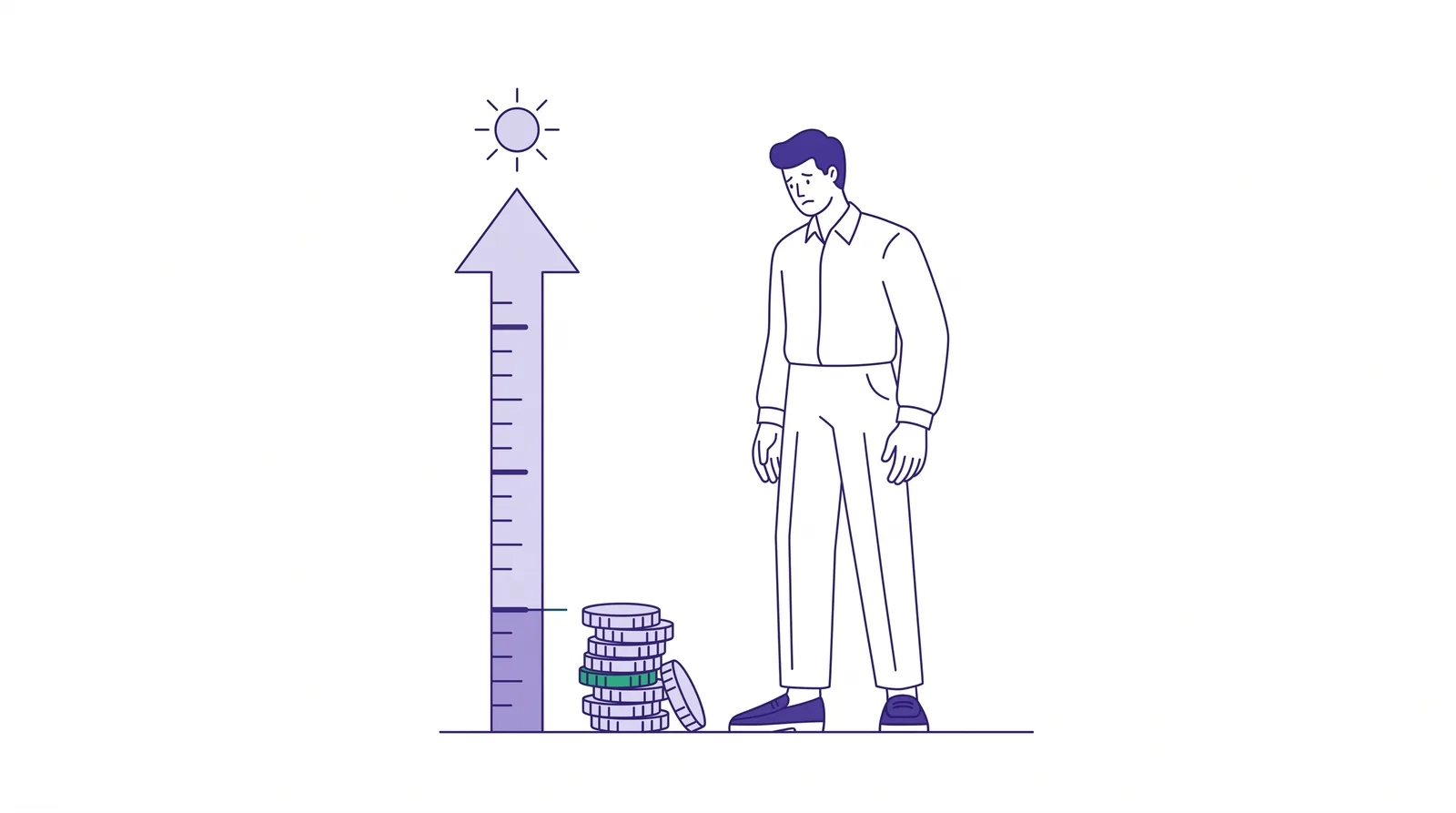
Your end-of-service gratuity will not fund your retirement. It is a one-off lump sum, typically a few months to a couple of years of basic salary, while retirement needs 20 to 30 years of income. In the worked example below, a 10-year career earns AED 127,500 of gratuity against a retirement need of roughly AED 3.6 million. That is not a pension. Here is the maths, and what to do about the gap.
What is gratuity actually designed to do?
End-of-service benefit (EOSB), commonly called gratuity, is a statutory severance payment under Article 51 of Federal Decree-Law 33/2021. Full-time private-sector expat employees earn 21 days of basic salary per year for the first five years of service and 30 days per year after that, capped at two years' total pay. The full mechanics are in our complete UAE gratuity guide and how to calculate gratuity under Article 51.
It was designed as a severance cushion for workers who would eventually go home, not as a retirement system. Three design features make that clear:
-
It is calculated on basic salary only, and many UAE packages deliberately keep basic at 50 to 60% of total pay. Check how your own split affects it with the payslip decoder.
-
It is paid once, in cash, with no requirement or mechanism to convert it into income.
-
It does not compound. A dirham of gratuity earned in year one is still one dirham in year twenty, minus inflation.
Worked example: 10 years of gratuity vs a real retirement need
Take an expat earning AED 25,000 a month, with a basic salary of AED 15,000 (a common 60% split), who completes 10 full years and resigns.
Daily basic salary: 15,000 / 30 = AED 500.
| Service period | Accrual | Calculation | Amount |
|---|---|---|---|
| Years 1 to 5 | 21 days per year | 21 x 500 x 5 | AED 52,500 |
| Years 6 to 10 | 30 days per year | 30 x 500 x 5 | AED 75,000 |
| Total gratuity | AED 127,500 |
Now the other side of the ledger. Suppose this person wants to retire at 60 and expects to spend a modest AED 12,000 a month in retirement (no rent, no school fees). Over a 25-year retirement that is:
12,000 x 12 x 25 = AED 3,600,000 in today's dirhams.
The gratuity covers AED 127,500 of that: about 3.5%, or roughly 10 months of spending. Even doubling the salary or the service length leaves gratuity covering a small fraction of a multi-decade retirement. Run your own numbers with the gratuity calculator and then the retirement gap calculator to see the two figures side by side.
Why does gratuity fall so far short?
It grows linearly while retirement needs compound
Gratuity accrues at a flat 21 or 30 days per year. There is no investment growth on the accrued balance. Meanwhile the cost of your future retirement rises with inflation every year. A pension fund invests contributions for decades; gratuity just adds days of salary.
It is unfunded employer debt
Mainland gratuity is not held in a fund. It is a liability on your employer's books, paid only when you leave. If the company fails, your gratuity ranks with other claims. Funded schemes such as DIFC's DEWS were created precisely to fix this. See DEWS and other end-of-service savings schemes.
Job changes keep resetting the clock
Each new employer starts you back at the 21-day band for five years. An expat who changes jobs every four years never reaches the 30-day accrual at all, and each payout tends to get spent rather than invested.
Basic salary caps the base
Because allowances are excluded, a package structured as 50% basic halves the gratuity compared with the headline salary people mentally plan around.
How big is the gap, and what closes it?
In the example above the gap is roughly AED 3.47 million. To build that over the 25 working years from 35 to 60, at an illustrative 7% average annual return, you would need to invest around AED 4,400 to 4,500 a month. Start at 45 instead and the required amount roughly triples. The tool that matters here is time, not the gratuity formula.
Practical sequence:
-
Compute your projected gratuity and treat it as a bonus, not the plan.
-
Work out your real retirement number with the retirement gap calculator.
-
Set up automatic monthly investing into low-cost diversified funds. Our guide on how to build a private retirement plan in the UAE walks through the options, and start investing in the UAE as a beginner covers the first steps.
-
When gratuity or DEWS money does land, invest the lump sum rather than absorbing it into spending.
FAQ
Is gratuity enough to retire on if I worked 20 or 30 years in the UAE?
Rarely. Thirty years on an AED 20,000 basic salary produces roughly AED 570,000 before the two-year-pay cap is considered. That is a strong lump sum, but it funds only about four years of AED 12,000-a-month spending. It helps; it does not replace a pension.
Does gratuity earn any interest or investment return?
No. Mainland gratuity is a formula based on days of basic salary. It earns nothing while it accrues. Only funded schemes like DEWS or the Voluntary Savings Scheme under Cabinet Resolution 96/2023 invest contributions.
Is gratuity calculated on basic or total salary?
Basic salary only. Allowances for housing, transport and the rest are excluded. See is gratuity calculated on basic or total salary.
What should I do with my gratuity when I receive it?
If retirement is the goal, invest it as a lump sum in the same diversified portfolio as your monthly savings. Parking it in a current account or spending it on a car is how most gratuity value quietly disappears.
Related reading
Sources and References
-
UAE Government portal, end of service benefits in the private sector; the 21 and 30 day gratuity accruals and the two years' pay cap under Federal Decree-Law 33/2021 Article 51 (u.ae)
-
Morgan Lewis, The UAE Alternative Savings Scheme: An Update; the funded alternative under Cabinet Resolution 96/2023 and its contribution rates (morganlewis.com)
-
Zurich Workplace Solutions, DEWS employee pages; how funded workplace savings differ from unfunded gratuity (zws.zurich.ae)
This article is for general information and does not constitute financial advice. Gratuity rules, scheme terms and investment returns change, so confirm your entitlement against current MOHRE guidance and base retirement decisions on your own figures or licensed advice.
Published on 9 September 2026.