The CBUAE 50% Debt Burden Ratio Cap, Explained
-
The rule: all your monthly debt repayments combined (loans, car finance, credit cards, overdrafts) must not exceed 50% of your gross salary plus regular income. It comes from Article 7 of CBUAE Regulation 29/2011 and applies to every bank and finance company in the UAE.
-
The DBR is checked at every new application. If a proposed instalment would push you past 50%, the bank must decline or reduce the loan, regardless of your salary or credit score.
-
For retirees and pensioners the cap drops to 30%, and loans that run past retirement age must be structured so repayments fit within that lower limit.
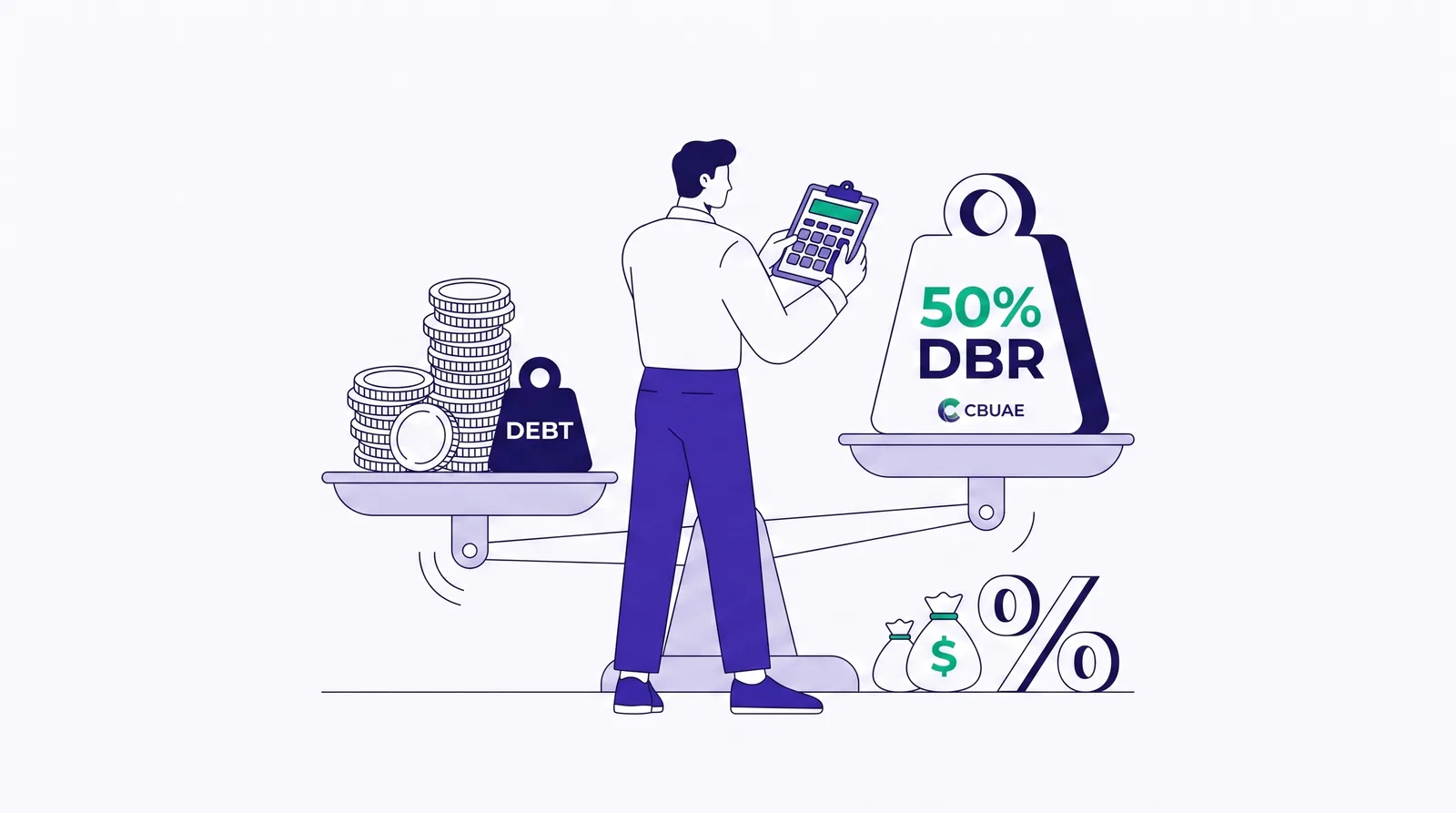
The Debt Burden Ratio is the single most important number in UAE consumer lending. It decides how much you can borrow before your credit score even enters the conversation.
The formula
DBR = total monthly debt obligations ÷ gross monthly income
Both sides have precise definitions:
The numerator includes every committed repayment: personal loan instalments, car loan instalments, mortgage payments, and your credit card obligation. For cards, banks typically count a percentage of the limit or outstanding balance (commonly 5%) as a monthly commitment, even if you pay in full. An unused AED 40,000 card limit can therefore consume AED 2,000 of your monthly borrowing headroom.
The denominator is gross salary plus regular income from a defined and specific source: base salary, fixed allowances, and documented recurring income such as rent. Bonuses and other non-guaranteed income are discounted or excluded. End-of-service benefits cannot be counted as a repayment source.
Where the rule comes from
Article 7 of Regulation 29/2011 states that deductions for all types of loans together, including car loans, housing loans, overdrafts, and credit card facilities, must not exceed 50% of gross salary and any regular income at any time. Two related caps sit alongside it: a personal loan cannot exceed 20 times monthly salary, and its tenor cannot exceed 48 months. Car loans are separate (up to 80% of vehicle value, up to 60 months) but their instalments still count inside the same 50%.
For mortgages, the CBUAE adds a stress test: lenders must confirm your DBR holds even if the interest rate rises 2 to 4 percentage points above the current rate.
A worked snapshot
Salary AED 25,000. Existing car loan instalment AED 2,200. Credit card limit AED 30,000, counted at 5% = AED 1,500. Committed so far: AED 3,700 (14.8%). Your remaining headroom is AED 8,800 per month, which is what a new personal loan or mortgage instalment can occupy. For the full arithmetic including what loan size that headroom translates to, see how much you can actually borrow in the UAE, or get your own number instantly with our free DBR & Loan Affordability Calculator.
What people get wrong about the 50%
-
It's a ceiling, not a target. The regulation explicitly instructs banks not to automatically lend up to the maximum; they must consider your circumstances. Many banks apply internal caps below 50% for lower salaries.
-
Unused credit limits count against you. Cancelling or reducing dormant card limits is the fastest way to free borrowing capacity before an application. Note the trade-off: closing cards also affects your credit file, as covered in what hurts your AECB score.
-
It's measured "at any time," not just at approval. Top-ups and rescheduling beyond your eligibility are prohibited, which is why an over-50% borrower cannot simply borrow more to cope. The regulated way out is restructuring, covered in how to get out of debt in the UAE.
-
DBR and credit score are independent gates. The DBR caps how much you can afford; your AECB score prices your risk. You need to pass both, and the score side is covered in our guide to minimum AECB scores by product.
Why the rule exists
The cap guarantees that at least half your income remains available for living costs, and it protects the system from the over-leverage cycles that preceded it. For you, it is best treated as a planning constraint: know your committed percentage before the bank calculates it for you.
Sources and References
-
CBUAE Rulebook, Regulation No. 29/2011 Regarding Bank Loans & Other Services Offered to Individual Customers, Articles 2, 3 and 7 (rulebook.centralbank.ae)
-
CBUAE Rulebook, Clarifications and Guidelines Manual for Regulation 29/2011 (rulebook.centralbank.ae)
-
CBUAE Rulebook, Regulations Regarding Mortgage Loans, Article 3 (rulebook.centralbank.ae)
This article is for general information and does not constitute financial advice.